
 by

Katy MUD taxes are the line on the tax bill that surprises more Katy homebuyers than any other. You find a home you love, the price fits, the payment looks right — and then the tax statement shows a municipal utility district charging hundreds of dollars a month on top of the school and county taxes. This guide explains them in plain language: what they are, what they cost on a real Katy home, which districts charge what, and how to check the exact rate on any address before you make an offer.
The short version: a MUD is a small local government that built the water, sewer, and drainage for a newer Katy neighborhood, and homeowners repay those bonds through a separate property tax. Katy MUD taxes run from about $0.22 to $1.50 per $100 of assessed value, so on the median Katy home at $334,900 they add anywhere from about $737 to $5,024 a year. The rate depends entirely on the district, which is why two homes at the same price can carry very different monthly payments.
In this guide:

New Katy homes usually sit inside a MUD — check the rate before you offer.
What is a MUD tax?
A MUD tax is a property tax charged by a Municipal Utility District, usually shortened to MUD — a special-purpose local government created under the Texas Water Code to bring water, sewer, and drainage to an area where no city provides those services yet. When a developer builds a new subdivision outside the City of Katy limits, the city does not pay for the pipes, the treatment plant, or the storm drainage. The MUD does, by selling tax-exempt municipal bonds, and the homeowners inside the district repay those bonds over time through the MUD tax.
That is the whole idea behind Katy MUD taxes: they spread the cost of the neighborhood’s infrastructure across the people who live there, instead of loading it onto the purchase price. The trade-off is a separate line on your property tax bill every year for as long as the bonds are outstanding. The MUD tax is not a fee, not a one-time charge at closing, and not part of your HOA dues. It is an ad valorem property tax, calculated from your home’s taxable value, just like the school and county taxes.
MUDs are real governments, not private companies. Each one is overseen by the Texas Commission on Environmental Quality (TCEQ) and run by a five-member board elected by the property owners inside the district, which sets the rate every year after a public hearing. Most of greater Katy sits outside the City of Katy limits, so Katy MUD taxes touch a large share of Katy buyers: Cinco Ranch, Cross Creek Ranch, Firethorne, Elyson, Sunterra, and most other big master-planned communities are served by MUDs, not by the city.
How Katy MUD taxes work
Katy MUD taxes pay for two things. The first and usually larger part is debt service: repaying the bonds that built the original water lines, wastewater treatment, storm drainage, and sometimes roads. The second part is operations and maintenance: the ongoing cost of running the water and sewer systems and paying for engineering, legal, and administrative work. A MUD can only levy an operations and maintenance tax after the voters inside the district approve it at an election.
The rate is expressed the same way as every other Texas property tax: dollars per $100 of taxable value. A MUD rate of $0.65 per $100 means you pay $0.65 for every $100 of your home’s taxable value — not 65 percent of the value, and not a flat fee. The formula is simple: taxable value divided by 100, multiplied by the MUD rate. On a $334,900 home with a $0.65 MUD rate, the math is $334,900 ÷ 100 × $0.65, which comes to about $2,177 a year.
Katy MUD taxes in 2025 and 2026: real district rates
Katy MUD taxes vary enormously, even between neighborhoods a few minutes apart. Harris County’s adopted 2025 MUD rates ranged from $0.00 to $1.50 per $100, and across Texas the typical range runs from about $0.25 to $1.50 per $100. Where a district lands depends almost entirely on how much bond debt is still outstanding and how mature the neighborhood is. Remember the MUD stacks on top of school, county, and city taxes, so compare the combined rate, not the MUD line alone. Here are real 2025 Katy-area district rates from the appraisal districts’ published tables:
| District | 2025 rate per $100 | Yearly Katy MUD taxes on a $334,900 home |
|---|---|---|
| Interstate MUD | $0.305 | $1,021 |
| Fry Road MUD | $0.32825 | $1,099 |
| Fort Bend County LID 7 | $0.32274 | $1,081 |
| Cinco MUD 1 | $0.355 | $1,189 |
| Fort Bend County MUD 142 | $0.597 | $1,999 |
| Grand Mission MUD 2 | $0.75 | $2,512 |
| Katy West MUD | $0.80 | $2,679 |
| Willow Creek Farms MUD | $1.15 | $3,851 |
| Sunterra MUDs (Waller Co. MUD 37 and Harris-Waller Co. MUD 5) | $1.50 | $5,024 |
The pattern is the story of Katy MUD taxes in one picture. The older, built-out districts — Fry Road, Interstate, Cinco MUD 1 — sit in the $0.30 to $0.36 range, because their bonds are mostly paid down and the tax base is large. Mid-age districts like Grand Mission and Katy West sit around $0.75 to $0.80, while the newest communities, like Sunterra, sit at the $1.50 ceiling, because the infrastructure is brand new and the bonds are at their largest.
Two warnings belong with these numbers. First, rates are adopted every year, so a 2025 rate is a snapshot, not a promise — confirm the current rate for the exact address before you write an offer. Second, some newer communities also carry a public improvement district (PID) assessment on top of the MUD tax. Ask whether a PID applies — it is easy to miss, and it adds to the same monthly payment.
What Katy MUD taxes cost each month
Your lender collects property taxes through escrow, so Katy MUD taxes show up in your monthly mortgage payment — which is why the MUD rate matters so much at the offer stage. Here is what the MUD slice alone costs on the median Katy home, priced at $334,900 according to the Houston Association of REALTORS® September 2026 report:
| MUD rate per $100 | Yearly MUD tax | Monthly, in escrow | Typical for |
|---|---|---|---|
| $0.35 | $1,172 | $98 | Mature districts like Cinco MUD 1 |
| $0.65 | $2,177 | $181 | Mid-range Katy MUD taxes |
| $0.80 | $2,679 | $223 | Katy West MUD |
| $1.15 | $3,851 | $321 | Willow Creek Farms MUD |
| $1.50 | $5,024 | $419 | Newest communities like Sunterra |
On a $500,000 home the same rates bite harder: a $0.65 MUD adds about $3,250 a year, or about $271 a month, while a $1.50 MUD adds about $7,500 a year, or about $625 a month. The gap between the cheapest and the most expensive MUD on that home is $4,250 a year — more than $350 a month — for the same house, in the same school district, at the same price. That is why a lower-priced home in a high-MUD community can cost more per month than a higher-priced home in a low-MUD one.
One timing trap applies to Katy MUD taxes on new construction: the final MUD rate often is not set yet when you buy, so the builder can only estimate it. Once the neighborhood is finished and the bonds are finalized, the real rate can come in higher, and your lender will adjust your escrow a year or two later. Ask for the current total tax rate in writing and budget for the top of the estimated range.
The full Katy tax stack: MUDs are only one layer
To see what Katy MUD taxes really mean, you have to see the whole stack. A Katy tax bill is made of separate rates set by separate taxing units. Here are the layers for the 2025 and 2026-27 tax years, as adopted:
| Taxing unit | Rate per $100 | Notes |
|---|---|---|
| Katy ISD | $1.1171 | 2026-27, adopted Sept. 21, 2026; $0.7271 operations + $0.39 debt service; flat for the third straight year |
| Harris County (combined county lines) | ~$0.6241 | 2025-26; general fund $0.38529 plus flood control, hospital district, and Port of Houston |
| Fort Bend County (with drainage) | ~$0.422 | 2025; general fund $0.412 plus drainage district |
| City of Katy | $0.425 | 2025, unchanged from 2024; only for homes inside the city limits |
| MUD | $0.00–$1.50 | Varies by district; see the rate table above |
Most Katy homes do not pay every layer: city homes pay the city rate instead of a MUD rate, and the county layer depends on whether the home sits in Harris, Fort Bend, or Waller County. Katy ISD itself spans parts of all three across roughly 181 square miles. In Katy-area MUD communities the combined rate commonly lands around $2.90 to $3.30 per $100, roughly 2.9 to 3.3 percent.
Real communities show the spread. Lakes of Katy, which has no MUD at all, runs about 1.83 percent combined for 2025. Cinco Ranch runs roughly 1.8 to 2.7 percent depending on the section and its MUD. Firethorne adopted 2.2041 percent on its Katy ISD side and 2.2260 percent on its Lamar CISD side for 2026.
Ventana Lakes was about 2.79 percent for 2025. Sunterra runs 3.28 to 3.35 percent, with each of its five MUDs levying $1.50 per $100. On the median $334,900 home, 1.83 percent is about $6,129 a year and 3.35 percent is about $11,219 a year — a gap of roughly $5,090 a year, or about $424 a month, before exemptions. On a $500,000 home in a Harris County MUD community, the stack is about $4,022 for Katy ISD (after the $140,000 exemption), $3,121 for the county, and $3,250 for a $0.65 MUD — roughly $10,393 a year, or about $866 a month.
Do Katy MUD taxes go down over time?
Usually, yes. Katy MUD taxes almost always follow the same arc: they start high and gradually decline as the bonds are paid off and more homes join the tax base. Harris County MUD 120, in the Katy area, started at $1.50 per $100 in 1977 and had dropped to $0.40 per $100 by 2024, a 73 percent decrease over 47 years. Ventana Lakes has seen its MUD rate drop every year since 2016.
But the decline is not guaranteed, and it is not fast in the early years. A district can keep its rate flat or raise it if it issues new bonds, takes on new infrastructure, or faces higher operating costs, and the biggest drops tend to come late, when the original bonds are finally retired. If you are buying in a brand-new community at a $1.50 MUD rate, do not budget as if the rate will be $0.40 next year — plan on the current rate, and treat any future decline as a bonus.
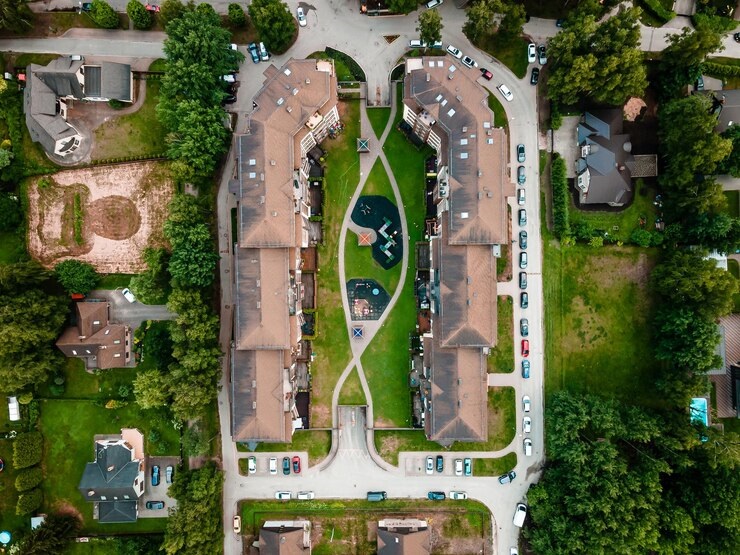
Master-planned communities like this one are usually served by a municipal utility district, not the city. The MUD built the water, sewer, and drainage — and the tax repays those bonds.
MUD taxes are not HOA dues (and not your water bill)
Three charges get confused with Katy MUD taxes. First, the MUD tax is not your HOA dues: the association maintains common areas, pools, and amenities and charges dues under a separate contract, while the MUD is a government that built and runs utilities and charges a property tax. A home can have both, one, or neither, and the amounts are unrelated.
Second, the MUD tax is not your water bill — the tax repays the bonds and funds the system, while the monthly water and sewer bill pays for the water you use. You pay both. Third, it is not a PID assessment, a separate charge some newer communities add on top of the MUD for amenities and landscaping. When you compare two homes, add up the MUD tax, HOA dues, water bill, and any PID together; the listing price never tells you this.
How to check the MUD tax on any Katy home before you buy
Checking Katy MUD taxes for a specific address takes about ten minutes:
1. Pull the tax record from the appraisal district. Look up the address on the Harris Central Appraisal District (HCAD) site for Harris County homes, or the Fort Bend Central Appraisal District (FBCAD) site for Fort Bend County homes. The property record lists every taxing unit for that address, including the MUD name and its current rate.
2. Read the MUD line, not just the total. On the tax statement the MUD appears as its own line, separate from the school, county, and city lines. Note the district’s full name and the exact rate per $100 — two homes on the same street can sit in different districts.
3. Ask for the seller’s MUD notice. Texas Water Code Section 49.452 requires the seller to give the buyer written notice of the district and its rate before the buyer signs the contract — if the notice is skipped, the buyer can cancel.
4. Get a tax certificate. Before closing, the title company orders a tax certificate showing the current taxes due for every taxing unit, including the MUD. Compare it with the appraisal district record — if the numbers do not match, stop and ask why before you close.
5. Call the MUD’s operator and ask three questions: what the current rate is, whether the board plans to issue new bonds, and whether the district offers a local homestead exemption.
If you would rather not do this yourself, ask your agent to pull it — a Katy agent reads tax statements and MUD notices every week. The point is never to discover the MUD rate after closing, when the escrow adjustment arrives. For more on what it takes to buy in Katy, see our guide to how much income you need to buy a home in Katy TX and our guide to down payment help in Katy and Houston.
The homestead exemption and the 10% cap
Two protections cut the bite of Katy MUD taxes and the rest of the bill, but neither one is automatic. The first is the homestead exemption. For tax year 2026 the state school-district residence homestead exemption is $140,000, raised from $100,000 by Proposition 13 in November 2025 and applied retroactively to tax years beginning January 1, 2025. That $140,000 comes off your assessed value before the Katy ISD rate is applied, so on a $500,000 home the school tax is charged on $360,000, not $500,000. Homeowners 65 and older get an additional $60,000 school exemption, for a combined $200,000, plus a school tax ceiling that freezes their school tax at the amount they paid the year they qualified.
The catch is that the school exemption does not apply to the MUD. MUDs are not required to offer any homestead exemption at all, though a board can adopt a local option exemption of up to 20 percent of appraised value, with a minimum of $5,000. If your MUD has not adopted one, you pay Katy MUD taxes on the full appraised value even while the school slice is reduced.
The second protection is the 10 percent appraisal cap. Once you hold the homestead exemption, your home’s appraised value for tax purposes cannot rise more than 10 percent in a year. It takes effect the year after you first qualify and resets when the home changes hands. File for the exemption with the appraisal district for the county where the home sits — HCAD, FBCAD, or Waller County’s appraisal district — on the state’s Form 50-114. The standard deadline is April 30 of the tax year, with a late-filing window of up to two years, and since 2022 a buyer can file in the same year they purchase.
For background on how MUDs work statewide, see LegalClarity on MUD taxes in Texas and How Texas explains MUD taxes for homebuyers. For current rates, the appraisal district record for the exact address is the authority.
Frequently asked questions about Katy MUD taxes
What are Katy MUD taxes?
Katy MUD taxes are property taxes charged by a Municipal Utility District, a small local government that built the water, sewer, and drainage for a newer Katy neighborhood. Homeowners repay those bonds through a separate tax, usually $0.22 to $1.50 per $100 of assessed value.
How much are Katy MUD taxes on a $400,000 home in Katy?
It depends on the district. At a $0.35 MUD rate, the tax is about $1,400 a year ($117 a month). At $0.80 it is about $3,200 a year ($267 a month). At the $1.50 ceiling in the newest communities, it is about $6,000 a year ($500 a month). Always check the exact district rate for the address.
Do Katy MUD taxes go away?
They usually fall as the bonds are paid off and more homes join the tax base — Harris County MUD 120 fell from $1.50 in 1977 to $0.40 in 2024. Some districts eventually dissolve once the debt is retired, but a MUD can also issue new bonds, so the rate is set fresh every year and is never guaranteed to fall.
Are MUD taxes the same as HOA dues?
No. The MUD tax is a government property tax that repays infrastructure bonds, and it appears as a line on your tax bill. HOA dues are a private charge for common areas, pools, and amenities. A home can have both, and the amounts are unrelated, so compare the two together when you judge the monthly cost.
How do I find the MUD tax rate for a Katy address?
Look up the address on the Harris Central Appraisal District (HCAD) or Fort Bend Central Appraisal District (FBCAD) website — the property record lists the MUD name and its current rate. The seller must also give you a written MUD notice before you sign, under Texas Water Code Section 49.452.
Talk to Al about the home you are considering
Katy MUD taxes are address-specific, and the fastest way to a straight answer is to ask someone who reads tax statements and MUD notices every week. If you are looking at a home in Katy and want to know exactly what the MUD, the schools, and the county will cost you each month, call Al Mesrahi at (281) 513-8346 or email amesrahi@yahoo.com.
You can also browse homes for sale in Katy TX, search all Houston-area listings on HAR with Al Mesrahi, or read our guide to mortgage rates falling to 7.18% in Katy. With over 25 years of experience in Katy and Houston real estate, Al will run the numbers for the exact home you are considering, so the tax bill never surprises you after closing.



Join The Discussion